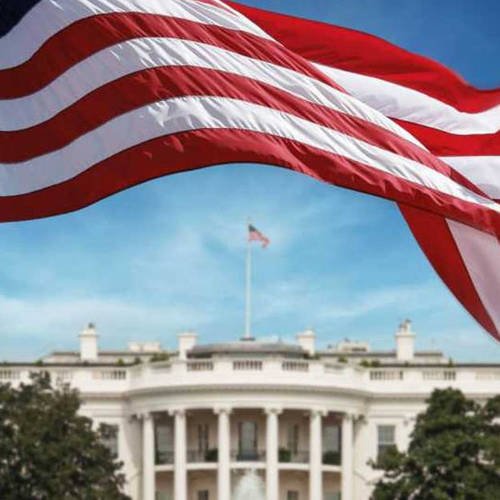
President Donald Trump on Friday said he has banned several media outlets from the White House in a move that could test the limits of his powers and the First Amendment.
In a post on Truth Social, Trump said the ban would cover CNN, MSNOW and Politico. He claimed the move was because of the “constant ‘reporting’ [of] FAKE NEWS!”

Download the Straight Arrow app today to get the stories that matter free from manipulation, bias or agenda.™
Point phone camera here
“Media Outlets shouldn’t be able to constantly write or report FICTION and LIES when they’re covering the President of the United States, the Trump Administration, or the United States of America,” Trump wrote.
He didn’t give any examples of what purportedly fabricated or fake coverage. However, in the past he has used the same term to describe stories he disliked.
In the post, Trump added: “Other Fake News Media Outlets to follow.” But he gave no additional details on the threat.
Reactions roll in
CNN responded to the ban on X, saying it would be “an illegal assault” on the First Amendment. The company said the government had no right to prevent its team’s reporting.
“CNN stands fully behind our White House team and their fair and accurate reporting,” the company wrote. “We have a right under the U.S. Constitution to do that reporting without hindrance or interference from the government.”
Press freedom advocacy groups, like the Freedom of the Press Foundation, also responded to the move, saying it couldn’t “imagine a more blatant violation of the First Amendment”
“The historically unpopular president has been retaliating against the press for years, but it hasn’t helped him,” the FPF wrote. “These outrageous attacks only demonstrate how scared he is of an informed public.”
Aaron Terr, the director of public advocacy at the Foundation for Individual Rights and Expression, told Straight Arrow that the White House “must comply with the First Amendment.” He said the president is well within his rights to criticize the media, but bans are illegal.
“Press credentials aren’t a reward for loyalty to the government,” Terr said. “A free, even adversarial, press is a sign of our country’s strength. The public deserves to hear about its government from independent voices, not just its leader’s loyalists and allies.”
Previous fights with the media
The Associated Press has been a frequent target of the Trump administration during the president’s second term. When he returned to the White House in January 2025, Trump announced that he would change the Gulf of Mexico to the Gulf of America. Some groups, like Google, subsequently supported the change and updated their official maps.
But others didn’t, like The AP, which said it wouldn’t update its style guidelines because the publication covers news worldwide and the president’s change didn’t require other countries to follow the change. In response, the White House blocked The AP’s reporters from entering the White House during an event.
The outlet later sued three White House officials, arguing that blocking its reporters from the White House and the president violated the First Amendment. A federal judge agreed, ruling the government can’t choose which reporters get access based on viewpoint. The White House appealed, and in June, the U.S. Court of Appeals for the D.C. Circuit paused the majority of the federal judge’s order. It did, however, keep in place the requirement that Trump give the AP access to events held in larger spaces, Politico reports.
Months later, the AP went before a three-judge appeals panel seeking a permanent ruling, but the court hasn’t issued a final ruling.
Other members in the Trump administration have also limited media access. In May 2025, Defense Secretary Pete Hegseth restricted reporters’ physical movement inside the Pentagon. Then in September 2025, he went further, requiring all credentialed reporters to sign a pledge not to gather or report any information that wasn’t formally authorized for release by the Defense Department. Nearly every major outlet pushed back and refused to sign.
The New York Times sued the DOD, its spokesperson Sean Parnell and Hegseth over the restrictions in December of that year. In March, a judge blocked the enforcement, ruling it was unconstitutional. A month later, the judge said the Pentagon had violated his order blocking the restrictions, Reuters reported.
The administration has also focused on reporters’ sources after The New York Times reported that the Secret Service urged the president to leave a July NATO summit in Turkey on an older version of Air Force One instead of the newer Qatari-donated jet. The Department of Justice later subpoenaed the four reporters on the story, with federal agents showing up to at least one of their homes to compel them to reveal their sources.
The DOJ eventually dropped the subpoenas after a federal judge questioned the government’s justification at a hearing.
The Trump administration also targeted a Washington Post reporter over a story she published about her sources inside the federal government. FBI agents raided her home and seized devices, saying they were investigating a federal contractor who allegedly retained classified documents. Days after the raid, a federal judge ordered that the FBI could not access the devices. A judge issued a subsequent ruling again denying access to the devices but did not order the FBI to return the devices, Politico reported.
Legal cases target media
Axios reports that Trump, his administration and his business have filed 25 lawsuits against media companies since Trump returned to the White House in January 2025.
In July 2025, Trump sued The Wall Street Journal after it published a birthday card that they claimed was written by Trump to convicted sex offender Jeffrey Epstein. Trump is seeking $10 billion in damages, but a federal judge dismissed the original complaint. The president later filed an amended complaint in May, and it is pending. The Journal has moved to dismiss it again.
In December 2025, the president sued the BBC for $10 billion over a documentary he claimed selectively edited a portion of a speech he made before the Jan. 6 Capitol riots, saying the edits made it look like he urged supporters to riot. The BBC apologized for the editing but denied defamation. The suit narrowed in July, and a trial is scheduled for February 2027.
Trump sued The New York Times in September 2025 over two articles from 2024 and a book by two Times reporters, saying the publications defamed him ahead of the elections, and sought $15 billion. Federal judge Steven Merryday dismissed the initial complaint but allowed Trump to refile it, which he did weeks later.
The case remains open after the president refiled his complaint a second time in late August.
One of the only settled cases between Trump and the media was the president’s lawsuit against CBS and Paramount. In October 2024, before the 2024 presidential election, Trump filed a lawsuit against the media company over how it edited an interview with Democratic presidential candidate Kamala Harris on its programs. Trump alleged they used deceptive editing to make her answer to a question about Israel better.
The president originally sought $10 billion but later amended it to $20 billion. Paramount, CBS News’ parent company, settled with Trump, agreeing to pay $16 million in July 2025. The settlement received criticism because Paramount was in the middle of a merger with Skydance Media, which has personal ties to Trump. Since the Federal Communications Commission had to approve the merger, some raised concerns that it contributed to the settlement.
Round out your reading
- He built his own Flock-style camera to track police. The police didn’t like it.
- Trump’s apparent joke about letting Iran bomb LA and San Diego catches bipartisan condemnation.
- Grandparents are fighting for access to their grandchildren. Here’s what the law says.
- When the ‘victim’ is made with AI, child pornography cases get complicated.
- Fibermaxxing is trending. Here’s what the science says.