
Commentary
-
Our commentary partners will help you reach your own conclusions on complex topics.
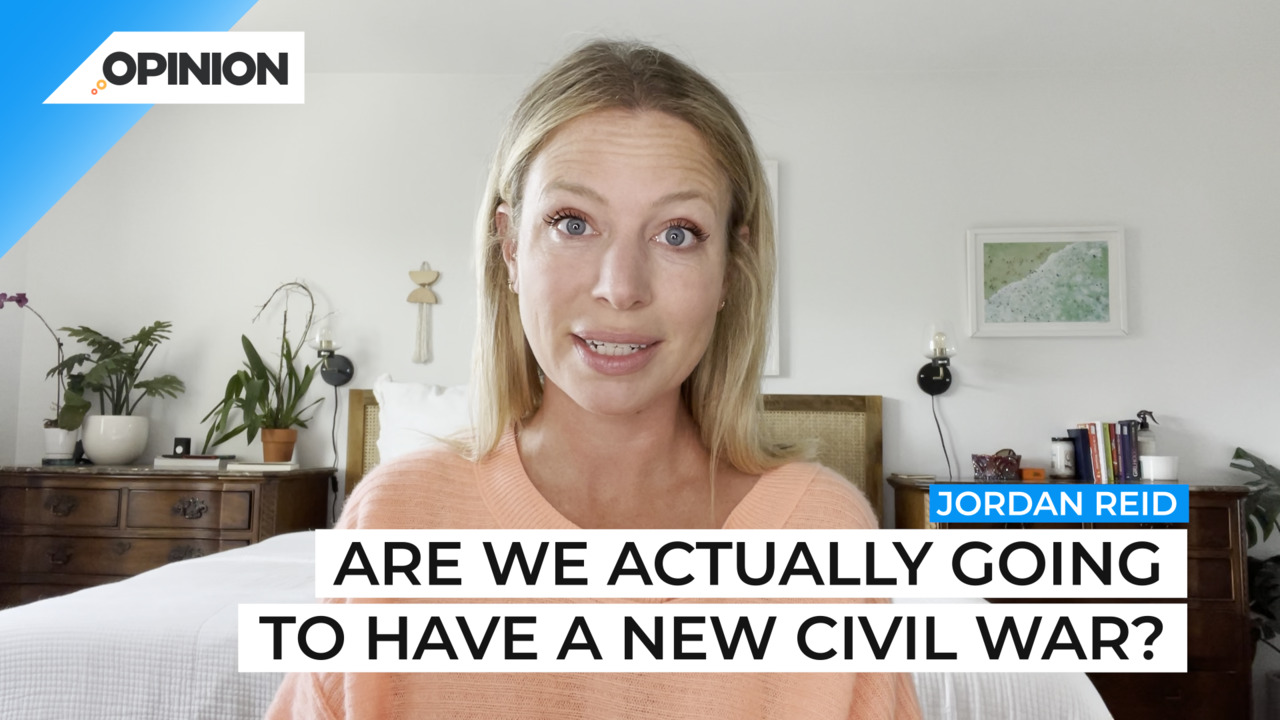
Like many of you, I’ll never forget Election Night 2016. I put my children to bed, whispering to my two-year-old daughter “When you wake up, you’ll discover that a woman can be anything” and settled with my cocktail for a joyful evening…and ended up several hours later crying in the bathtub. I remember calling my parents the next day and saying to them something along the lines of “We are going to have the second Civil War,” and them saying something to the effect of “Slow your roll.” We were all upset, but we still believed that the guardrails of democracy would hold. And that saying anything else was merely histrionics.
This whole “are we actually going to have a new Civil War” question, I’m not gonna lie, it does occasionally keep me up at night. And while I may have first said it more or less so someone would say “Oh come on, things aren’t that bad” – I can’t help but increasingly, terrifyingly, believe that it may come to pass.
In October 2020, Business Insider published a poll saying that the majority of Americans already believed we were in the midst of a “cold” Civil War.
Last fall, the University of Virginia Center for Politics released a poll finding that a majority of people who had voted to reelect Donald Trump in 2020 now wanted their state to secede from the Union, and also found that a whopping 41% of those who had voted for Joe Biden agreed with the statement that it might be time to “split the country.”
Now, to be clear, I don’t think we’re going back to the 1860s, with citizens grabbing their muskets and running out to defend their country, but the recent overturning of Roe V. Wade shows just how deeply the problem of states’ rights versus federal rights runs in this country.
We are already seeing states pass legislation with major implications within their own borders that differs wildly from that passed in neighboring states, and the toxic political atmosphere that has been stirred up in the past few years has only made that idea of extreme measure more palatable.
Oh, right. And as of right now, there are 393 million guns in civilian possession in the United States, and private militia groups are flourishing.
While the United States used to qualify as a “full democracy,” it is now considered a “partial democracy” along the lines of Somalia or Haiti.
That said, most of the entities calling for civil war are private entities with limited power, not public ones with the ability to compel citizens to do their will
The conflict is also less between states than within them – specifically, between metropolitan areas, which tend to go blue, and more rural populations, which are overwhelmingly red.
Government officials remain in a position to penalize citizens who engage for anti-democracy acts. This isn’t a fun topic but On the pro side, a second Civil War likely won’t look how we imagine. On the con side…a second Civil War likely won’t look how we imagine.
More from Jordan Reid
-
Trump disgraces Oval Office with shameful treatment of Zelenskyy
On Feb. 28, U.S. President Donald Trump hosted Ukrainian President Volodymyr Zelenskyy at the Oval Office of the White House in a televised state visit that escalated into an argument and ended with Zelenskyy’s abrupt departure. The purpose of the visit, ostensibly, was to formalize an agreement for continued U.S. support of Ukraine in its… -
RFK Jr.’s war on psychiatric meds risks decades of progress
On Feb. 18, during his first meeting with staff, Health and Human Services Secretary Robert F. Kennedy Jr. stated that he intends to address the possible overmedication of children and the risks of antidepressants — echoing a Trump executive order aimed at reducing childhood chronic disease rates. The order has sparked concerns over youth access… -
Loss of USAID makes America and the world less safe
Elon Musk and President Trump shocked the U.S. foreign policy community and America’s partners around the world with the early and abrupt closure of USAID, the United States Agency for International Development. USAID was a cornerstone of U.S. foreign policy and consistently received bipartisan support from Congress. Experts warned that the decision puts millions of… -
Trump’s ‘Gulf of America’ renaming is mere political spectacle
Aboard Air Force One, en route to the Super Bowl in New Orleans, President Trump held a news conference. As the flight entered international waters over the Gulf of Mexico, he issued an executive order renaming it the “Gulf of America” and declaring Feb. 9 as “Gulf of America Day.” The order, titled Restoring Names… -
President Trump politicizes DC plane crash as Americans mourn
Sixty-seven people died when a Black Hawk helicopter crashed into American Airlines Flight 5342 as it came in for a landing at Reagan National Airport on the night of Jan. 29 outside of Washington, D.C. Investigators are still examining the accident and putting details together, but believe that the helicopter was flying at too high…


Latest Opinions
-
 Getty Images
US changes course, pauses tariffs for all USMCA goods until April 2
-
 AP Images
More than half of global fossil fuel-related CO2 emissions linked to 36 companies
-
 Getty Images
Zelenskyy foes met with Trump camp, oppose wartime election: Report
-
 Getty Images
Trump preparing to sign executive order to begin closing Department of Education
-
 Getty Images
Fake bomb threat called during Pro-Palestinian protest at Barnard College
Popular Opinions
-
In addition to the facts, we believe it’s vital to hear perspectives from all sides of the political spectrum.