

Commentary
-
Our commentary partners will help you reach your own conclusions on complex topics.
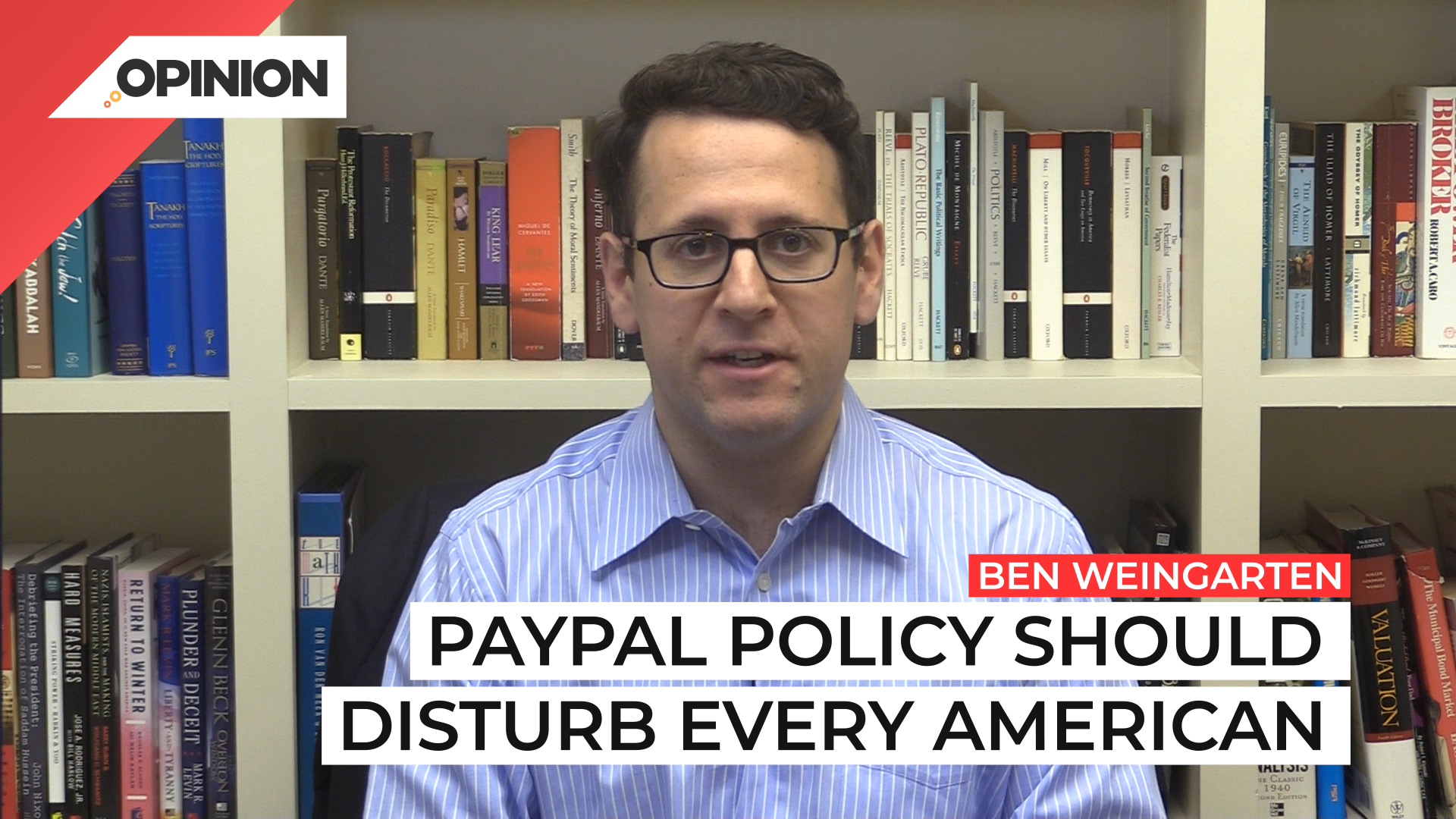
PayPal just gave us a sneak peek at America’s fast-approaching dystopian future: A social credit system with American characteristics. And it should disturb every American, and drive a deep cultural, political, and legal backlash.
The payment processing company, one of the largest nonbank lenders in the world with some $75 billion in assets in 2021, recently modified its user agreement, threatening to fine those who QUOTE, “use…PayPal…for activities that involve the sending, posting, or publication of any messages, content, or materials that, in PayPal’s sole discretion … promote misinformation” at a rate of up to $2,500 per violation. When the world got wind of this policy, the criticism was, rightly, swift and massive. The stock tanked.
PayPal’s former president David Marcus even panned the company, tweeting:
“It’s hard for me to openly criticize a company I used to love and gave so much to. But @PayPal’s new AUP goes against everything I believe in. A private company now gets to decide to take your money if you say something they disagree with. Insanity. “
So PayPal backtracked.
A spokesman said that the updated “acceptable use policy” had gone “out in error that included incorrect information. PayPal is not fining people for misinformation and this language was never intended to be inserted in our policy… We’re sorry for the confusion this has caused.” But no one should be confused. Taking the company at its word, while it might have accidentally released the policy, it still drafted it.
That means at very minimum it contemplated being an arbiter of truth – determining what counts as misinformation and pilfering people’s accounts to punish them should they engage in Wrongthink. And it already applies subjective measures to mete out punishment against its users – generally cutting in one ideological direction.
PayPal’s acceptable use policy already had language calling for fines up to $2,500 per violation for those using the product to engage in “the promotion of hate, violence, racial or other forms of intolerance that is discriminatory.”
In a world where up to half the country is classified as semi-fascist by the president, where conservatism, which calls for a colorblind society antithetical to bigotry, and a rule of law antithetical to violence – is equated by our betters with bigotry and violence, one can imagine how arbitrarily such a policy could be applied to ideological undesirables.
Consider who PayPal has punished in the past. Just weeks ago, PayPal allegedly shut down the account of “Gays Against Groomers,” a self-identified “coalition of gays against the sexualization, indoctrination and medicalization of children.”
The group’s founder said it had never received a violation before and that it was simply notified that it had violated Paypal’s user agreements – without specifying where.
Around the same time, PayPal also suspended the account of Great Britain’s Free Speech Union, described as an “organization which defends gender-critical academics and people who have lost work for expressing opinions,” as well as that of its founder, and his website the Daily Sceptic.
All reportedly because of again unspecified violations of its Acceptable Use Policy. As we explored in a recent episode, the effort to push both the private sector and government to pursue those who would dare challenge radical gender ideology is strong, so PayPal’s efforts would be consistent with that trend. Years ago – all the way back in 2017 – PayPal briefly barred the account of prolific counterjihadist scholar Robert Spencer, and it has barred plenty of others on the right as well.
The payment processing outlet’s efforts go beyond targeting critics of the left, to even leftists who challenge establishment orthodoxy. Months earlier, two “alt” news sites that might seemingly be described as the dissident left, had their PayPal accounts suspended without explanation.
One of the purged thinks PayPal may have done so based on a purported violation of another restricted activity, “Provid[ing] false, inaccurate or misleading information” – which would again be in the eye of the beholder.
PayPal’s contemplating of the chilling standard that it quickly revoked, but apparent application of similar standards, illustrates a trend we have already seen accelerating in recent years: The targeting of those who hold beliefs that challenge the prevailing orthodoxy of America’s ruling elites using public and private sector power—a running theme in my Straight Arrow News commentaries.
Amazon can pull your book. Facebook and Twitter can censor and silence you. And yes, financial institutions can de-bank you.
PayPal’s pulled language should serve as, and maybe even was meant to serve, as a warning: Comport your beliefs with those of the Ruling Class, or else.
If we assume that dissent on virtually every major issue is ultimately going to be cast by those in government, Woke Capital, Big Tech, and beyond as fake, if not hateful, and violent dangerous – because these institutions cannot tolerate threats to their monopoly on power and influence – then the assumption has to be that every institution may well impose a standard like the one PayPal laid out. Whether implicitly or explicitly, du jour or de facto.
That is a direct threat to our livelihoods, our freedoms, and our ability to function as a society. Therefore, all on the left or right who believe in preserving any semblance of this country must fight back against viewpoint discrimination.
And they will likely need to use the force of law to achieve it, given the corruption of our civil society, and its loss of respect for free speech, and tolerance of dissent.
More from Ben Weingarten
-
‘Deep State’ failed to protect Trump
The stated mission of the United States Secret Service is to “ensure the safety and security of our protectees.” However, on July 13 in Butler, Pennsylvania, the Secret Service allowed a lone would-be assassin to fire a shot at former President Donald Trump, grazing his ear with a bullet. Secret Service Director Kimberly Cheatle resigned…
-
The Regime once again meddling in election to hurt Trump
On Tuesday, July 9, the U.S. Department of Justice issued a cybersecurity advisory warning companies about a Russian social media bot farm. U.S. officials told reporters that these Russian bots are targeting U.S. voter groups in key swing states and implied that the goal is to undermine President Joe Biden. Watch the above video as…
-
Clarence Thomas has it right on presidential immunity case
On July 1, the United States Supreme Court ruled in a 6-3 majority opinion for Trump v. United States that American presidents have absolute immunity from prosecution for actions that fall within their constitutional duties. The ruling asserts that evidence of official criminal acts committed by a president cannot even be presented in any U.S.…
-
SCOTUS’ Murthy v. Missouri ruling will live in infamy
On June 26, the U.S. Supreme Court sided with the federal government in the Murthy v. Missouri case regarding official communications between the government and social media platforms. In a 6-3 decision written by Justice Amy Coney Barrett, the court stated that the plaintiffs did not have the legal standing to seek an injunction against…
-
Anti-Trumpers care about power, not democracy
News commentators across the political spectrum — including some contributors here at Straight Arrow News — have warned Americans about Donald Trump’s aspirations to make himself a dictator and effectively end the American republic if he regains power in November. Their warnings cite Trump’s own legal arguments, public statements and past behavior, including the attempted…
Latest Opinions
-
 U.S. Department of Defense
Congress still trying to figure out how to reduce wasteful military spending
-
 DVIDS
DVIDS
US Navy, Air Force making waves with new weapons at RIMPAC
-
 Getty Images
Israeli PM Netanyahu meets with Trump at Mar-a-Lago
-
 Getty Images
Growing US nuclear power resurgence reaches the nation’s heartland
-
 Getty Images
Beer from the sun, other solar thermal projects get government funding
Popular Opinions
-
In addition to the facts, we believe it’s vital to hear perspectives from all sides of the political spectrum.