
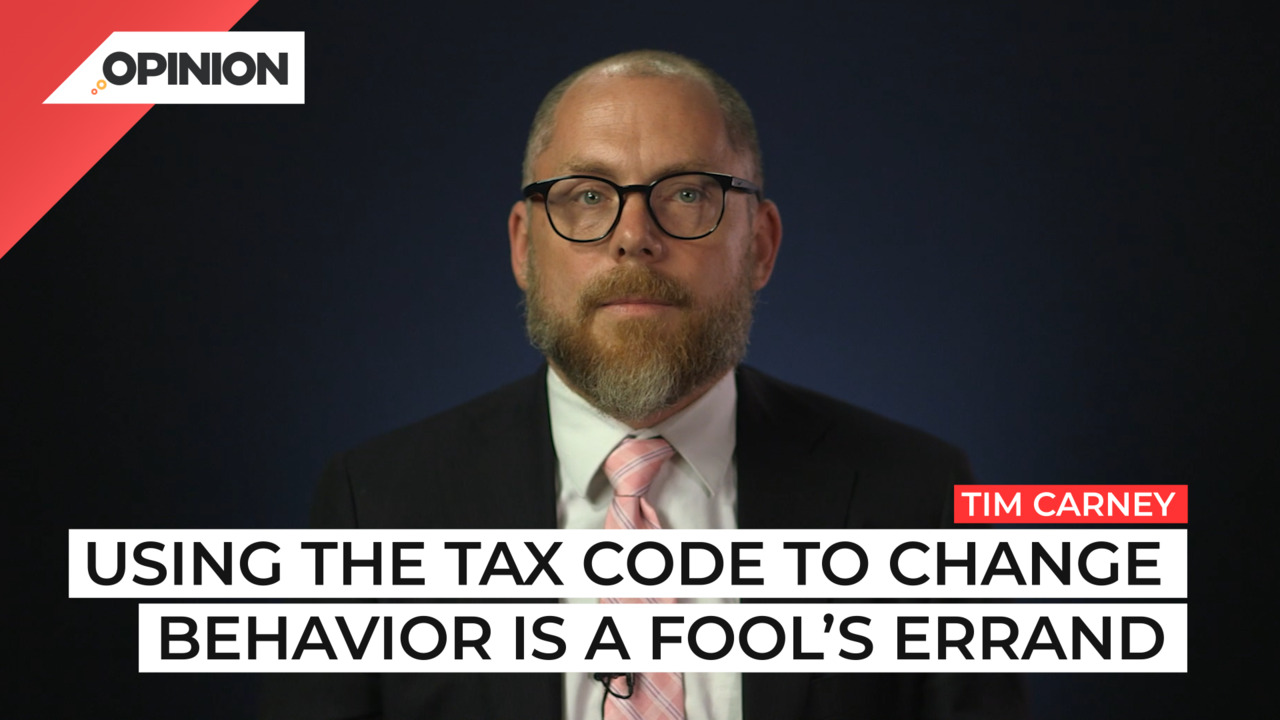

Commentary
-
Our commentary partners will help you reach your own conclusions on complex topics.
Taxes. You may see them as the way government generates revenue. But politicians have a grander vision of taxes. They see the tax code as a way to change how you and I behave. They create alcohol taxes to discourage drinking. Tariffs to push us towards more American made goods and green tax credits to get us to buy the stuff they think will help the environment.
But human behavior and capitalism are complicated. They are beyond the understanding of our tax writers. And so the best laid plans often go awry. The result? Unintended consequences and ever increasing complexity.
One recent example is the electric vehicle tax credit. In an effort to decrease gasoline usage, Congress in 2008 created a $7,500 tax credit for anyone who buys a plug-in electric vehicle.
The unintended consequences were plenty. For starters, the average Tesla buyer is not exactly middle class, which meant this was mostly a subsidy for the very wealthy.
Also, driving up demand for electric vehicles creates all sorts of environmental consequences. Deep sea mining is the most efficient way to find the materials needed for electric vehicles batteries. It also threatens to have massive costs on the ecosystems way down there.
What’s more, key parts of the electric vehicle supply chain were based overseas, including in China, meaning these tax credits were subsidizing Chinese companies.
Finally, subsidizing the purchase of a Tesla allows Tesla to charge more. So some of the tax credit was passed through to profit a company owned by the world’s richest man.
To mitigate exactly this problem, and to prod all carmakers towards plug-in vehicles, Congress had specified that only the first 200,000 buyers from each automaker could get the tax credit.
As a result, cars from Tesla and GM were no longer eligible for the tax credit by the time Joe Biden took office.
Hoping to phase out the internal combustion engine altogether, Democrats this year stuck a new electric vehicle tax credit into the poorly named Inflation Reduction Act.
This time around, Congress was determined to avoid some of the harms of the last tax credit. So they set income limits on taxpayers who could claim the credit, they set cost limits on cars eligible for the credit. They set Made in America rules and union labor rules.
The result is a very complicated tax credit, which doesn’t even apply to most electric cars sold in the U.S.
A tax incentive that confuses the average taxpayer will not be much of an incentive at all. The cost of complying with a complicated tax law will fall on the IRS, car dealers and car buyers, thus adding deadweight loss to the economy.
And there’s no reason to believe Congress has eliminated all the harmful unintended consequences. What will be the harms of this new lobby? Who knows?
You see part of what makes government meddling in the economy so dangerous is the unpredictability of these distortions. But we can guess.
Look at California, which is trying to abolish the gasoline car. Their electric grid is overwhelmed and the government is telling people to curb their electric usage.
If you’ve already swapped out gasoline for electricity for your car’s fuel, it’s pretty hard to conserve electricity.
Other consequences of this tax credit, we’ll find out when they happen. The lesson here isn’t that electric cars are bad. It’s that using the tax code to change behavior is a fool’s errand.
More from Timothy Carney
-
How Biden’s tax on Chinese metal harms Americans
President Joe Biden announced plans to triple tariffs on Chinese steel and aluminum to protect American jobs from “unfair” competition. The White House said China is hurting the U.S. economy by selling steel at very low prices. Watch the video above as Straight Arrow News contributor Timothy Carney argues that while Biden’s new tariffs might…
-
Democrats use climate change issues to help sell liberal agenda
According to a January survey, only 12% of Republicans say dealing with climate change should be a top priority for the president and Congress, ranking the issue last among the 20 included in the survey. By contrast, 59% of Democrats say climate change should be a top priority for the president and Congress. While Democrats may…
-
HHS Secretary Becerra’s crusade against Catholicism
When President Joe Biden took office, he nominated Xavier Becerra, a former California congressman and attorney general, to run the U.S. Department of Health and Human Services (HHS). As California’s attorney general, Becerra was at the forefront of legal efforts on health care. In his current position as HHS secretary, Becerra is a strong proponent…
-
Universities must blame themselves for protest hypocrisy
U.S. college protests over the Israel-Hamas war have divided college campuses, often pitting university officials and executives against their own students and faculty. And yet, as Straight Arrow News contributor Timothy Carney points out, many of today’s university officials are actually the anti-Vietnam War protesters of a previous era’s student protest movement. Today, those same…
-
Subsidizing demand won’t fix real problems
The Biden administration recently announced an initiative to cap child care copay expenses for approximately 100,000 low-income working families in the United States. Instead of paying set fees, those families will pay 7% of whatever their total income is as a copay for the government-subsidized daycare program. The program also hopes to fully cover all…

Latest Opinions
-
 U.S. Department of Defense
Congress still trying to figure out how to reduce wasteful military spending
-
 DVIDS
DVIDS
US Navy, Air Force making waves with new weapons at RIMPAC
-
 Getty Images
Israeli PM Netanyahu meets with Trump at Mar-a-Lago
-
 Getty Images
Growing US nuclear power resurgence reaches the nation’s heartland
-
 Getty Images
Beer from the sun, other solar thermal projects get government funding
Popular Opinions
-
In addition to the facts, we believe it’s vital to hear perspectives from all sides of the political spectrum.